Short answer: it depends on the lease. If the lease includes the flat’s front door in the leaseholder’s property, the leaseholder usually pays to repair or replace it. If the landlord keeps the door as part of the building, the cost normally comes back to leaseholders through the service charge, provided the lease allows it. Communal fire doors in corridors and stairwells are the landlord’s responsibility and are usually paid for through the service charge. Whoever pays, the landlord or managing agent is responsible for the building’s fire safety, including the flat entrance doors.
This guide is a plain-English summary of the rules in England for leaseholders, freeholders and managing agents. It is not legal advice: your lease and your building’s fire risk assessment are the documents that decide what applies.
Which doors in a block of flats are fire doors?
- Flat entrance doors that open onto a common corridor, lobby or stairwell.
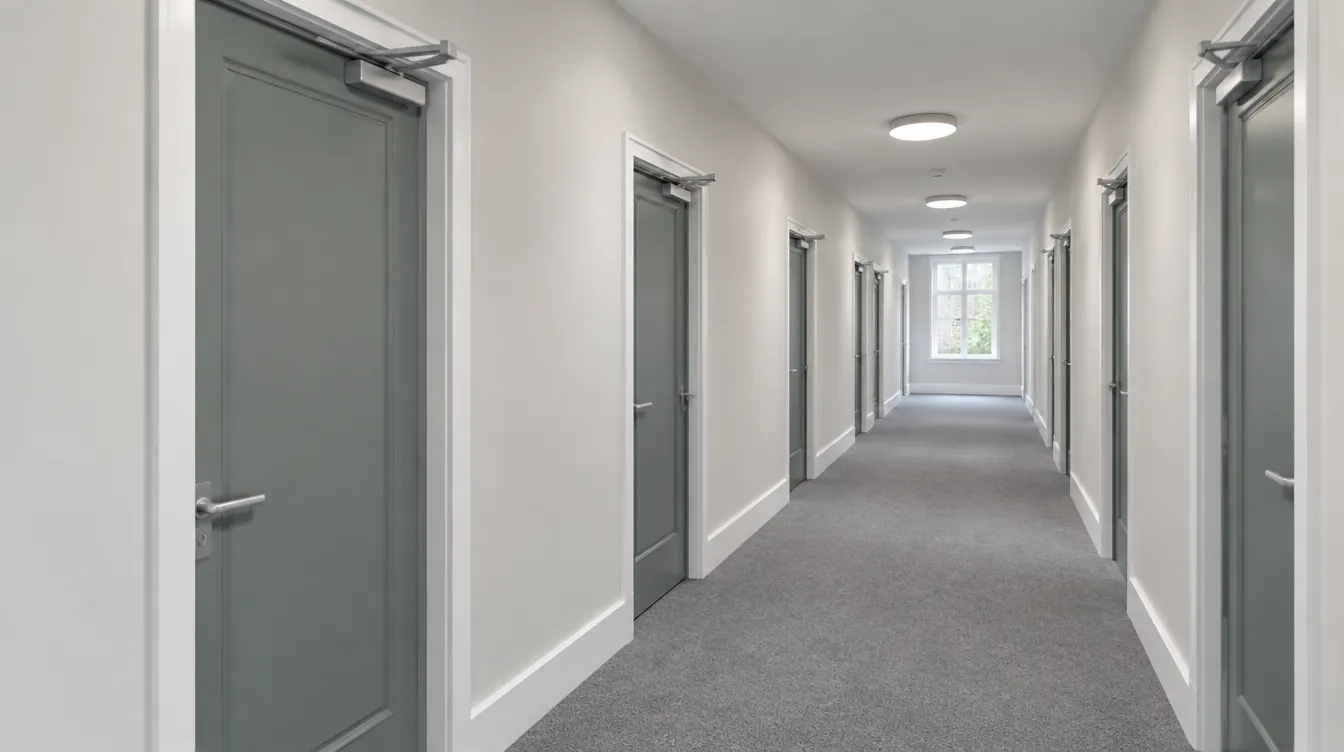
- Communal doors across corridors and to stairwells, which stop fire and smoke spreading through the common parts.
- Service doors in the common parts, such as bin stores, plant rooms, and meter or riser cupboards, where the fire strategy requires them.
Doors inside a flat are generally a matter for the leaseholder, although some flat layouts rely on fire doors off the internal hallway.
What does the lease say?
Start with the part of the lease that describes what is included in the flat, often called the demise, and the landlord’s repairing obligations. Some leases include “doors and door frames” in the flat. Others keep the entrance door as part of the structure, and some split it, giving the leaseholder the door but keeping the frame.
| Situation | Who usually pays |
|---|---|
| The lease includes the flat entrance door in the leaseholder’s property | The leaseholder |
| The lease keeps the entrance door as part of the building | The landlord, recovered through the service charge if the lease allows |
| Communal doors in corridors and stairwells | The landlord, usually recovered through the service charge |
| The lease is unclear | Take advice before agreeing to pay. The Leasehold Advisory Service gives free initial advice |
Even when the leaseholder owns the door, the landlord still has fire safety duties for it, and many leases give the landlord a right of access to inspect and carry out work.
The rules landlords and managing agents must follow
Fire Safety Act 2021
Since 16 May 2022, the Act has made clear that the Fire Safety Order covers the structure, external walls and flat entrance doors of buildings containing two or more homes. The responsible person, usually the freeholder or managing agent, must consider the flat entrance doors in the fire risk assessment.
Fire Safety (England) Regulations 2022
In force since 23 January 2023. In every building with two or more flats and common parts, residents must be given information about fire doors: keep them shut when not in use, do not tamper with the self-closers, and report any fault. In buildings with storeys above 11 metres, the responsible person must also:
- check communal fire doors at least every three months, and
- use best endeavours to check flat entrance doors at least every 12 months.
Section 20 consultation
If the landlord’s works will cost any one leaseholder more than £250 through the service charge, the landlord must consult leaseholders under section 20 of the Landlord and Tenant Act 1985 before starting, or apply to the First-tier Tribunal for dispensation. The consultation has notice periods of at least 30 days, so allow for it in the programme. A replacement of every entrance door in a block will usually pass the threshold.
Building Safety Act 2022 protections
In buildings at least 11 metres high or with at least five storeys, qualifying leaseholders are protected from some or all of the cost of putting right historical building safety defects, which can include defective fire doors. Whether this applies depends on the building, the lease and the leaseholder, so take advice before agreeing to pay for this kind of work.
What a compliant replacement looks like
A flat entrance door onto a common corridor is usually specified as a 30-minute fire-resisting doorset with smoke seals, often written as FD30S, with a self-closing device. The building’s fire strategy or fire risk assessment sets the standard for your block.
- A doorset, not just a door: the door, frame, hinges, intumescent and smoke seals, closer, letterplate and any glazing should have test evidence or third-party certification as a combination.
- A working self-closer: the door should close fully into the frame and latch from any open position.
- Correct gaps: the gaps around the door should be within the manufacturer’s tolerances.
- Rated hardware: spy holes, letterplates and locks fitted to the door need to be suitable for a fire door.
- Records: keep the certificate and installation details for each door. The managing agent will need them for the fire risk assessment and future checks.
Ask any installer for the test evidence for the doorset, and whether they belong to a third-party installer scheme such as BM TRADA Q-Mark or FIRAS.
If you are a leaseholder replacing your own door
- Read the lease, then ask the managing agent for consent before you order anything.
- Ask what standard the building requires. It will be in the fire risk assessment or fire strategy.
- Use a certified doorset and a competent installer.
- Give a copy of the certificate to the managing agent once the door is fitted.
- Do not remove the self-closer or fit hardware that is not rated for a fire door.
If you are a managing agent planning a replacement programme
- Survey every door and record its condition, with photographs.
- Check the leases to separate what falls to the service charge from what falls to individual leaseholders.
- Run section 20 consultation where the cost per leaseholder will pass £250.
- Use one specification for every door, so the corridors stay consistent and certification is simple.
- Plan access flat by flat, with notice for each resident.
- Keep a record for every door for the fire risk assessment and the regular checks.
We replace flat entrance doors across buildings for managing agents, arranging access with each leaseholder, and price every door as its own line so leaseholders can see what they are paying for. See our fire door replacement service, our work for managing agents, and what leaseholders wrote about us.
Questions people ask
Who is responsible for the front door of a leasehold flat?
The lease decides. Some leases make the entrance door part of the leaseholder’s property, others keep it as part of the building. Either way, the landlord or managing agent is responsible for the building’s fire safety, including flat entrance doors.
Can my freeholder make me replace my front door?
If the lease makes the door your responsibility and it does not meet the fire safety standard for the building, the landlord may be able to require you to put it right, and some leases let the landlord do the work and recharge you. Check your lease and ask to see the fire risk assessment finding.
Who pays for fire door inspections in a block of flats?
Checks carried out by the landlord or managing agent are normally a service charge cost, provided the lease allows the landlord to recover it.
Can I change my flat’s front door myself?
Not with any door. A flat entrance door onto a common corridor is a fire door, so the replacement must meet the standard in the building’s fire strategy, and the lease will usually require the landlord’s consent.
How often must fire doors in flats be checked?
In buildings with storeys above 11 metres, communal fire doors at least every three months and flat entrance doors, on a best endeavours basis, at least every 12 months, under the Fire Safety (England) Regulations 2022.
Sources
- GOV.UK: Fire Safety (England) Regulations 2022
- legislation.gov.uk: Fire Safety Act 2021
- legislation.gov.uk: Landlord and Tenant Act 1985, section 20
- GOV.UK: leaseholder protections for building safety defects
- GOV.UK: Approved Document B, fire safety
- The Leasehold Advisory Service
Last reviewed 16 September 2026. General information for England, not legal, tax or financial advice.